Pages

Training the Mind of the Horse and Rider

Training the Mind of the Horse and Rider
Click on Logo (Original artwork by Lanie Frick for Messick Quarter Horses. Not permitted to be copied)
Showing posts with label Loping. Show all posts

Monday, January 9, 2012

Muscle Memory


I've just been glancing through the Centered Riding Book 1, and this statement caught my attention. "Changing old habits while riding". Muscle Memory.

I know we have muscle memory. And what our muscles tell us, or do to us, as in whatever position we hold, we think that is correct. Sometimes it is not, and we have to re-learn the correct way.

This was brought to my attention while I lope, besides other areas. When I lope, I lean back a little. To me, that is correct. When the instructor showed me where my body should be, I felt like I was leaning over the horse's neck.


As I'm changing my posture and balance, allowing my hips to open, and finding that neutral pelvis point that will also keep my legs under me, my upper body should improve. If my legs are forward, I'm leaning back. If my legs go to far back, it pushes me too far forward.

I ride a lot in 2 point, and that has brought me into a better alignment. I have found that balance point with my upper body, and I keep it when I sit. OR so I thought.

Tom took a few photos of me, which I posted on my Horses Are Our Lives blog. Not of me riding, just sitting still. But when I was loping Duke, I asked him where my alignment was, and guess what he told me? I was too far back!!! Not as much as 2 years ago, but still back when I loped Duke!
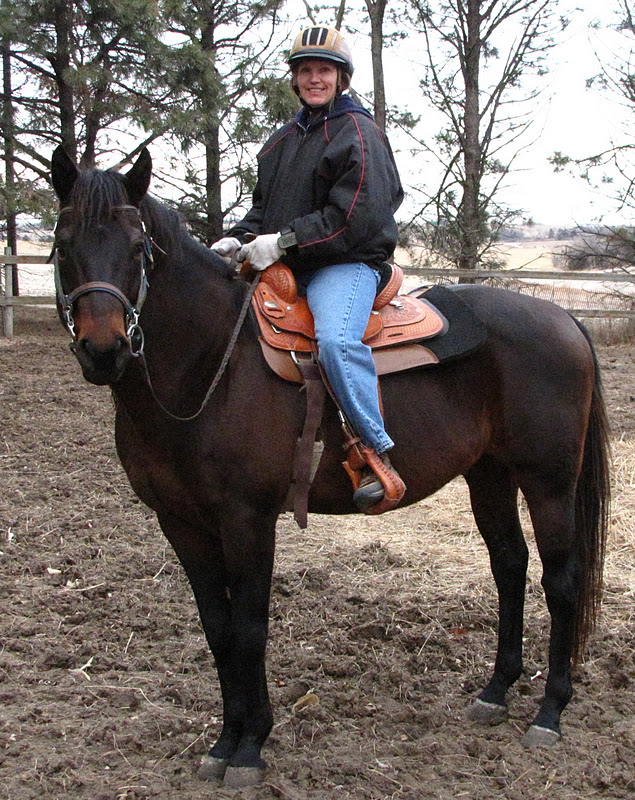


But I know why. That big boy has such a strong deep lope, he throws you back, even if you are in motion with his lope. But then that meant I was still behind the motion.

I went back to a little bit of 2 point and trotted him around. I loped him and asked Tom how it looked. Better, but still a little bit back.

Now that I know this when I canter, I make myself come a little forward. I need to learn new muscle memory.

The other area to remember that if you do this, don't let your back arch. Come forward, then flatten your lower back, keeping your seat bones in the seat.

Your lower back will thank you for this when you get done riding. You won't have a sore back if you remember to flatten your lower back, let yourself sink deep into your seat (no slumping), and then take a deep breath out and relax.

Do it now, while you're in a chair. You will like the feeling!

"Embrace the Journey!"
Brenda

Sunday, July 18, 2010

Teaching the Lope Lesson Part 2

I had a fantastic lesson last week, teaching 2 adults to lope the lesson horses. They did fantastic. Both were apprehensive, a little scared, and tense, but after showing what the horses can do on a lunge line, they both were loping short distances off the line!
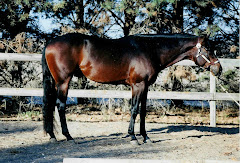
I got on Starlet first, to show how she lopes. I think that helped them a lot to see her lope, as it showed the riders what the horse will do and how the lope on her looks.

After the adult lesson, I had a youth lesson with a youth who has been with me awhile. She has loped a little for the last 2 years, but now at age 11, she was able to put it all together and lope Starlet around the arena a couple of times before stopping. I had a fantastic time with my youth rider too.

Yes, I can't wait to share how I did the lessons and what Centered Riding exercises I used. But what I will really share is the connection between the horse and rider. And the connection between Starlet and I.

The previous post, Teaching the Lope Lesson, Part 1, went through the exercises to get the rider prepared. The exercises did more to relax the rider as much as to “awaken” their joints and muscles. As the riders went through the exercises, they became more comfortable on the lesson horse. They were paying attention to how to do the maneuvers, and they could move the horse where they wanted the horse to go.

The riders started with leg exercises, to open up the hips. I had the riders find their Neutral Pelvis by rocking their pelvis back and forth. We worked on putting our head in alignment through the Building Blocks exercise. This helped the riders to lift their chin a little higher, and able to see further ahead. Using Soft Eyes, the riders could see more of the arena and where they were going to lope their horse. I had them Ground themselves, by feeling their weight into their feet, as if they are standing on the ground. I wanted them to feel the weight through their legs, into their feet, and moving down to the ground and feel like they could sink into the ground, as if they are standing in sand.

We worked on moving the horse with Breathing and using the rider’s Center. The horse needs to be moved with our center, as well as our hands and legs. Think about your center as a small ball moving backwards. If you want to have your horse move out, mentally spin the ball faster. If you need the horse to go slower, spin your center slower. If you need the horse to have a longer stride, spin your center larger. Have your center grow from a golf ball size to a beach ball size, or any size in between. Picturing a certain size ball spinning in your center will help you with your horse’s movement.

We also use our center by spinning in the direction that you want to go. As we prepare for the lope to the left, we want to spin our center forward and to the left.

We lope off with Clear Intent, We need to know, and express to our horse with exact cues, where we want to ride our horse to, at what speed, and knowing what to do if the horse breaks to a trot.

For my lesson horses, they will lope off better for people with these cues: I have the riders hold with light contact on the reins. I have the riders take a deep breath. I have them look in the direction they want to go, and as they breathe out, I have the rider squeeze with their outside heel. Depending on the horse, the leg cue can be soft with Chick or it needs to be firm with Starlet.

If the horse only trots, we stop the horse, take a step back to make sure we have enough control to stop the horse if we need to. Then we ask the horse to lope off with a more exact cue. As the rider looks ahead as he lopes, we continue to add enough leg cue to keep the horse loping.

When we use our Center and give the horse exact cues with Clear Intent, then we can do anything that we want to do. Practice and you can accomplish whatever you want to do.

“Embrace the Journey!”

Friday, July 16, 2010

Teaching the Lope

July 15, 2010
Part 1

I was exhausted the day after the lope lesson. I think the 4 days of having a vendor booth at State 4-H in the rain and humidity did me in. Then my lesson day started at 6 am, with lessons at 7. I’m still tired, but not as tired as last night. But the way I feel tonight, I still may not get this done. But I will start and post Part 2 tomorrow.

We worked on preparing for the lope. We worked on walking using the following seat. We learn to stay relaxed enough and trotting the arena. Working on control through stopping and backing.

Both adults are comfortable walking and trotting the lesson horses. They understand the Centered Riding exercises. We have been applying the exercises during the lessons. We also do leg exercises to loosen up the ankle, knee and hip joints, especially the hip joints. To get the leg back underneath our bodies, the leg has to move from the hip. Our pelvis needs to be open to do this, and we find our Neutral Pelvis to do this. As we engage our joints and open our hips, our body stay relaxed. We work on the Building Blocks and putting our bodies in alignment. Then we won’t bounce at the trot and the lope. We start with our head, moving to our hips and legs, rocking our body into balance.

We Ground our feet and feel the weight into our stirrup. We want to feel that we are standing in sand, yet feel like we our standing solid on the ground. Breathe and use Soft Eyes. We Center and we move the horse with our center. We allow the ball in our center to grow and go faster to get the horse to move out. We let the ball grow smaller and move slower to slow down the horse. We worked on half halting to the stop by breathing out and sitting deep in our seat.

We ride and moved our horses around the arena with Clear Intent, meaning we ride with a purpose. We need to look where we are going and put the horse there. Last week, we worked on maneuvers, and 2 tracked (half passed) into the corners. When we learn to use our legs as well as our hands to guide the horse, we gain more control. The riders are learning to feel how the horse’s move and to gain control when they lose the movement.

Next we transitioned into the lope. More tomorrow.

Wednesday, July 14, 2010

Learning to Lope

For tomorrow's lesson, I have an adult who wants to learn to lope. My lesson mare, Starlet, is great for this. She is a little western pleasure loper, very true and very smooth, if she goes slow. Starlet listens to my cues, so I have the rider on the lunge line, and we both cue Starlet for the lope. The rider gives the body cues, and I give my subtle cues with my voice and body. This gives the rider confidence in knowing how to execute the lope.

How will I use Centered Riding, and CR exercises? I will ground and center myself first. Then I will have the rider do some exercises while on the lunge line. Before asking for the lope departure, I'll have the rider breathe, center and have clear intent on asking for the lope. I'll let you know tomorrow how the morning goes.

Saturday, June 5, 2010

LB Moment about Using Your Center at the Lope

Another moment I had the other day was when I was going to lope off Shaggy. I
thought about what I had read in the Centered Riding 2 book.

Think about when you were sledding, and for me, that was many, many years ago.
You sat on the sled and someone pushed you to get you started down the hill.

If they pushed your shoulders, where did you go? You went forward, then as the
sled started, your shoulders were flung back and they were left behind your
body. This would be the same as if you leaned forward to lope off.

If the sled was pushed, your upper body was pushed back because your seat was
taken out from under you. This would happen if you kicked the horse to make him
lope.

But what happened if the person pushed you, at your waist, to make the sled go
down the hill? This is the area across your lower back and behind your center.
The sled moves easily and you stay upright. This is the same if you USE YOUR
CENTER TO LOPE OFF! LIGHTBULB goes off brightly!

Now when you are on the horse, use your center, not just your hip or legs, and
definitely not by leaning forward. As I went to lope off Shaggy, I centered
myself, and with my hip and center, I asked for the lope off. Still not pretty,
but my body stayed where it should have. I still have to kick him into the
lope, but I try to use my center as much as I can.

What a moment of clarity!!!

"TRAINING THE MIND OF THE HORSE AND RIDER"

Messick Quarter Horses

Check out my website at: http://www.messickquarterhorses.com/

Lessons, Training and Horse Sales
E-mail me at messickquarterhorses@yahoo.com

Messick Tack & Feed

Messick Tack & Feed
website will be up soon! Click on logo to see current specials!